
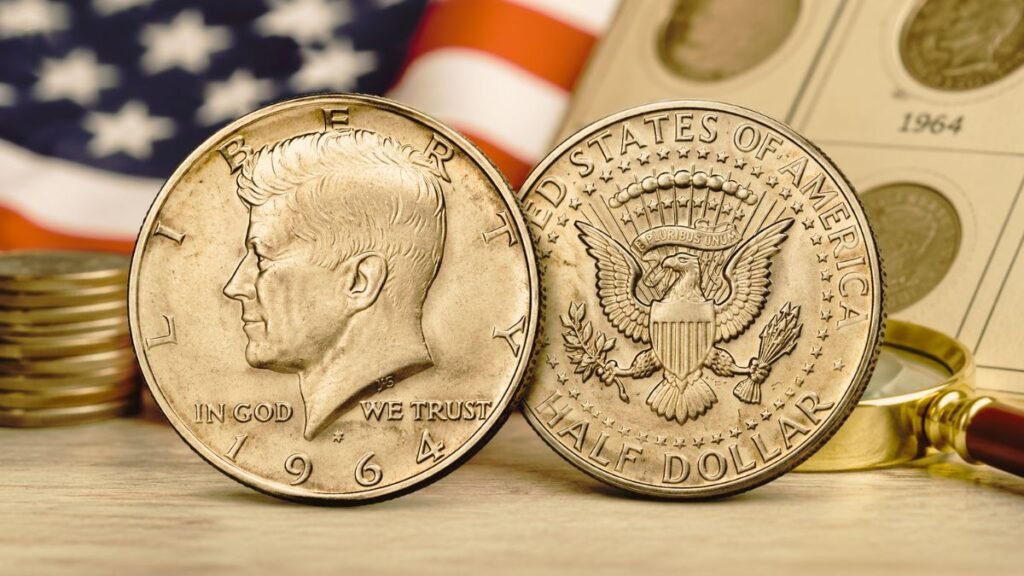
The 1964 Kennedy Half Dollar Value depends primarily on its 90% silver content, condition, and rare mint marks like the Accented Hair Proof
The Kennedy half dollar exists because of a tragic event. Following the assassination of President John F. Kennedy in Dallas on November 22, 1963, Congress acted swiftly. Lawmakers expedited the approval of a new half dollar design in honor of the late president. The new coin replaced the Franklin half dollar, which had been in production since 1948.
The design work also proceeded quickly. Mint sculptors Gilroy Roberts and Frank Gasparro quickly prepared the dies using existing work, and minting of the new coins began in January 1964. Roberts created the obverse portrait of Kennedy, while Gasparro designed the reverse, which features a large presidential seal.
Production progressed rapidly in early 1964. The Denver Mint began minting coins on January 30, 1964, about two weeks before Philadelphia. The first coins were minted on February 11, 1964, and officially went on sale on March 24, 1964.
Demand was overwhelming from day one. Nearly 26 million coins were sold in a matter of days, with lines stretching around city blocks at Treasury windows and bank counters. Many buyers never spent the coins. They kept them as a memento of the president they had just lost, which is why so many 1964 half dollars still exist in excellent condition.
Coin Specifications
The 1964 issue is the only Kennedy half dollar made entirely of 90% silver, for both business strikes and proofs. Here are the coin’s basic specs:
| Features | Details |
|---|---|
| Composition | 90% Silver, 10% Copper |
| Weight | 12.5 grams |
| Diameter | 30.6 mm |
| Silver Weight (ASW) | 0.3617 troy oz |
| Edge | Reeded |
| Designer, Obverse | Gilroy Roberts |
| Designer, Obverse | Frank Gasparro |
Starting with the 1965 coins, the Mint reduced the silver content by 40% to conserve metal as silver prices rose. This change lasted from 1965 to 1970, after which the Mint introduced a copper-nickel clad composition with no silver in 1971. This made the 1964 Kennedy half dollar the most silver-rich of the entire series.
How Many Made
The 1964 half dollar had one of the highest mintages ever for a silver half dollar. Here’s a breakdown by mint:
| Mint | Type | Mintage |
|---|---|---|
| Philadelphia (No Mint Mark) | Business Strike | 273,304,004 |
| Denver (“D”) | Business Strike | 156,205,446 |
| Philadelphia | Proof | 3,950,762 |
In total, this amounts to approximately 429.5 million business-strike coins and approximately 4 million proofs. Despite this large number, heavy hoarding by the public means that many of these coins never circulated and are in better condition than you would expect for such a common date.
Silver Melt Value Now
Because every 1964 half dollar contains real silver, its floor value fluctuates with the silver market. As of June 30, 2026, silver was trading at approximately $58.50 per troy ounce, after a volatile year in which prices rose above $121 per ounce in late January 2026, then fell sharply.
To find the melt value, multiply the silver spot price by the coin’s silver weight of 0.3617 troy oz. At $58.50 per ounce, this translates to approximately $21 per coin in raw silver value alone. This is still over 40 times the coin’s 50-cent face value.
Keep in mind that silver prices fluctuate daily, sometimes by several dollars per ounce. If you’re pricing a coin to sell, check the live spot price first, as melt figures constantly change with the market.
Value by Condition and Grade
A worn, circulated 1964 half dollar typically fetches close to its silver melt value, plus a slight premium from the dealer. Uncirculated and proof coins command higher prices because collectors pay not just for their metal content but also for their attractive appearance and rarity.
| Grade / Type | Typical Value Range |
|---|---|
| Circulated (worn) | Close to melt value, approximately $20-$25 |
| MS-63 to MS-65 (uncirculated) | $30-$150 |
| MS-67 or higher | Several hundred to a few thousand dollars |
| Proof PR-65 | Approximately $25 |
| Proof PR-66 Deep Cameo | Approximately $60 |
| Proof PR-68 Deep Cameo | Approximately $625 |
| Proof PR-69 Deep Cameo | Approximately $3,000 |
Top-grade survivors are truly rare. Based on overall population data, PCGS has certified 21 coins at MS67+ as of July 2025, while NGC has graded only four examples at MS68. This scarcity at the top of the grading scale drives auction prices significantly higher.
Rare Varieties to Look for
Not every 1964 half dollar is the same. Some design quirks and limited strikes can increase a coin’s value far beyond its typical melt or grade pricing.
- Accented Hair Proof: The initial proof die showed extra detail in Kennedy’s hair just above his ear. Jacqueline Kennedy disliked this feature, and the design was softened for the remainder of the 1964 proof mintage, with approximately 100,000 coins produced with the original accented hair look. To confirm this variety, look for the broken serif in the lower-left corner of the letter “I” in LIBERTY.
- Special Mint Set (SMS) Strike: This is the rarest non-error Kennedy half dollar. Only about a dozen examples have been discovered since the 2000s, each displaying a satin finish with sharp strikes and visible die polishing lines. One of these coins sold for $47,000 in 2016.
- High-Grade Business Strikes: Even common Philadelphia and Denver coins can command good money if they are of very high grades. An NGC MS68 example sold for $57,600 through Heritage Auctions on May 9, 2024, demonstrating that condition alone can elevate a common coin to a serious collectible.
The 1964 Kennedy Half Dollar has two levels of value. Each example contains genuine silver, worth approximately $21 at current prices, giving it a solid price floor regardless of its condition. Beyond that floor, sharp uncirculated coins, high-grade proofs, and rare varieties like accented hair proofs or SMS strikes can range in price from a few hundred to thousands of dollars.
Disclaimer: All the information provided in this article is for educational and infomational purposes only. DateUpdateGo always advises seeking guidance from a certified financial advisor before making any investment-related decisions.
