
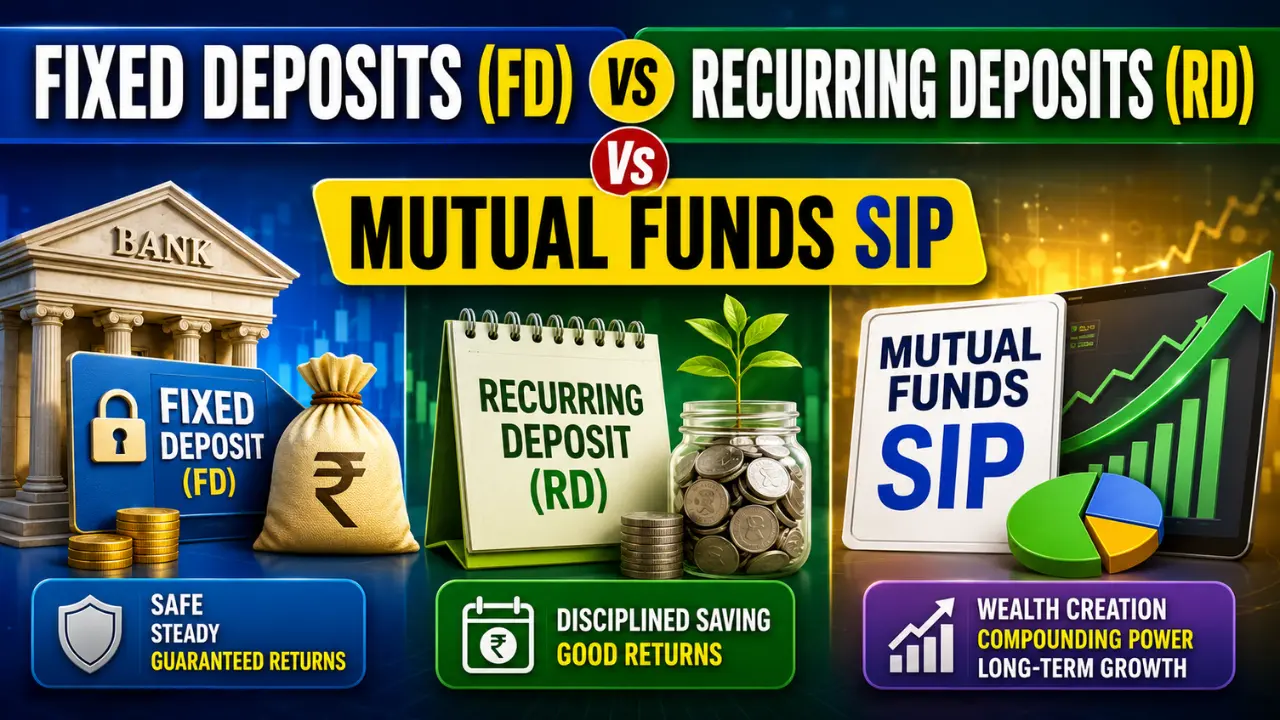
FD vs RD vs SIP: Managing money has become a pressing concern for most people these days, as everyone seeks both safety and growth for their savings. Many investors are often confused about where to invest their money so that it remains secure and generates good returns over time. The most common options include fixed deposits (FDs), recurring deposits (RDs), and systematic investment plans (SIPs). Each option serves a different purpose, and a clear understanding of them can help make informed financial decisions.
Fixed Deposits (FD)
Fixed deposits are one of the most reliable ways to keep money safe and receive regular returns. In this option, a person invests a lump sum amount for a fixed period, which can range from a few months to several years. The interest rate is pre-determined, so returns are predictable and stable throughout the investment period.
This type of investment is not affected by market fluctuations, making it ideal for those who are risk-averse. However, returns are typically lower than market-linked options. For example, FD interest rates often range between 5% and 7%, depending on the bank and the time period, making it ideal for investors who are primarily focused on safety.
Recurring Deposits (RD)
Recurring deposits work well for those who prefer to invest small amounts every month rather than a large sum at one time. This allows investors to deposit a fixed amount regularly, helping them develop a disciplined savings habit over time. Like FDs, the interest rate is fixed at the beginning, ensuring clarity about the final amount.
RDs are a good option for salaried individuals or beginners who want to gradually build a substantial corpus. Since returns are pre-determined and not linked to the market, the risk level is very low. This makes RD a comfortable option for those who want steady growth without worrying about sudden losses.
Mutual Funds SIP
Systematic Investment Plans, commonly known as SIPs, are related to mutual funds and offer a different way of investing. In this method, investors deposit a fixed amount every month into funds that invest in the stock market. Unlike FDs and RDs, returns are not fixed and depend on market performance.
Although SIPs carry some risk due to market fluctuations, they also offer the potential for higher returns in the long run. For example, equity mutual funds have generated returns of approximately 10% to 15% over the long term. This makes SIPs suitable for investors who are willing to take some risk for better growth.
FD vs RD vs SIP
The decision between FDs, RDs, and SIPs depends primarily on personal financial goals and risk tolerance. If safety and guaranteed returns are a priority, FDs and RDs are the more appropriate options. On the other hand, if the goal is to build wealth over the long term and take on some risk, SIPs become a better option. Simply put, conservative investors may prefer FDs or RDs, while those seeking higher returns over time may find SIPs a more profitable option.
Disclaimer: All the information provided in this article is for educational and infomational purposes only. DateUpdateGo always advises seeking guidance from a certified financial advisor before making any investment-related decisions.
