
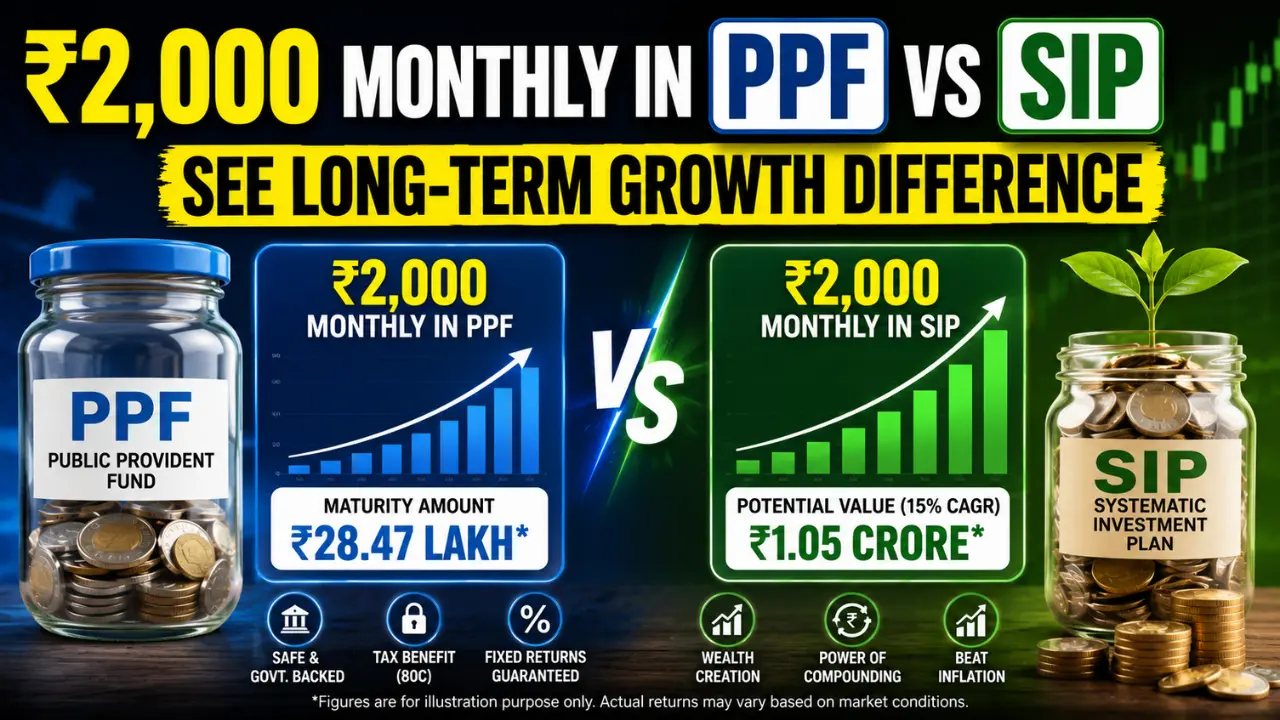
PPF vs SIP: Many people who try to save a small portion of their monthly income often have a common question: where should they invest so they can earn good returns without much worry. For those just starting out, there are usually two clear options. One is a safe and stable option backed by the government, and the other offers higher returns but carries some risk over time.
Public Provident Fund (PPF)
For those who want peace of mind and want their money to be safe, the Public Provident Fund, or PPF, is often seen as a reliable option. It is backed by the government, which means the risk is almost zero. Currently, it offers an annual interest rate of around 7.1%, making it a stable option for long-term savings.
If a person invests ₹2,000 in PPF every month, the total investment becomes ₹7.2 lakh in 30 years. At the given interest rate, this amount could grow to approximately ₹24 lakh to ₹25 lakh at maturity. One of the biggest advantages is that returns are tax-free, and the invested amount remains completely safe throughout.
Systematic Investment Plans (SIP)
On the other hand, Systematic Investment Plans (SIPs) in mutual funds offer the opportunity to grow wealth rapidly. These investments are linked to the stock market, so returns are not fixed. However, over the long term, the market has generally delivered good growth.
If the same ₹2,000 is invested every month through a SIP with an average annual return of 12 percent, the total value could reach approximately ₹62 lakh after 30 years. If the returns increase to 15 percent due to good market performance, the final amount could even exceed ₹1.2 crore. This shows that even a single month’s investment can yield very different results depending on where it’s invested.
PPF vs SIP
In the initial years, both PPF and SIP investments may seem similar, with slow growth that may seem unimpressive. However, the real impact is seen in later years, especially in the last decade. This is due to compounding, where returns are earned not only on the original amount but also on accumulated profits.
As time passes, the investment base expands, and even small percentage profits can yield significant growth. This is why long-term discipline, regardless of the option chosen, plays a key role in building wealth.
Large sums in SIP investments may be exciting, but it’s important to remember that they come with market risk. Economic recessions or global issues can temporarily reduce the value of investments. Investors should be prepared for such fluctuations.
In contrast, PPF offers complete stability and is unaffected by market fluctuations. Returns may be lower, but the safety is unmatched. The right choice depends on a person’s comfort level with risk, financial goals, and long-term planning approach.
Disclaimer: All the information provided in this article is for educational and infomational purposes only. DateUpdateGo always advises seeking guidance from a certified financial advisor before making any investment-related decisions.
