
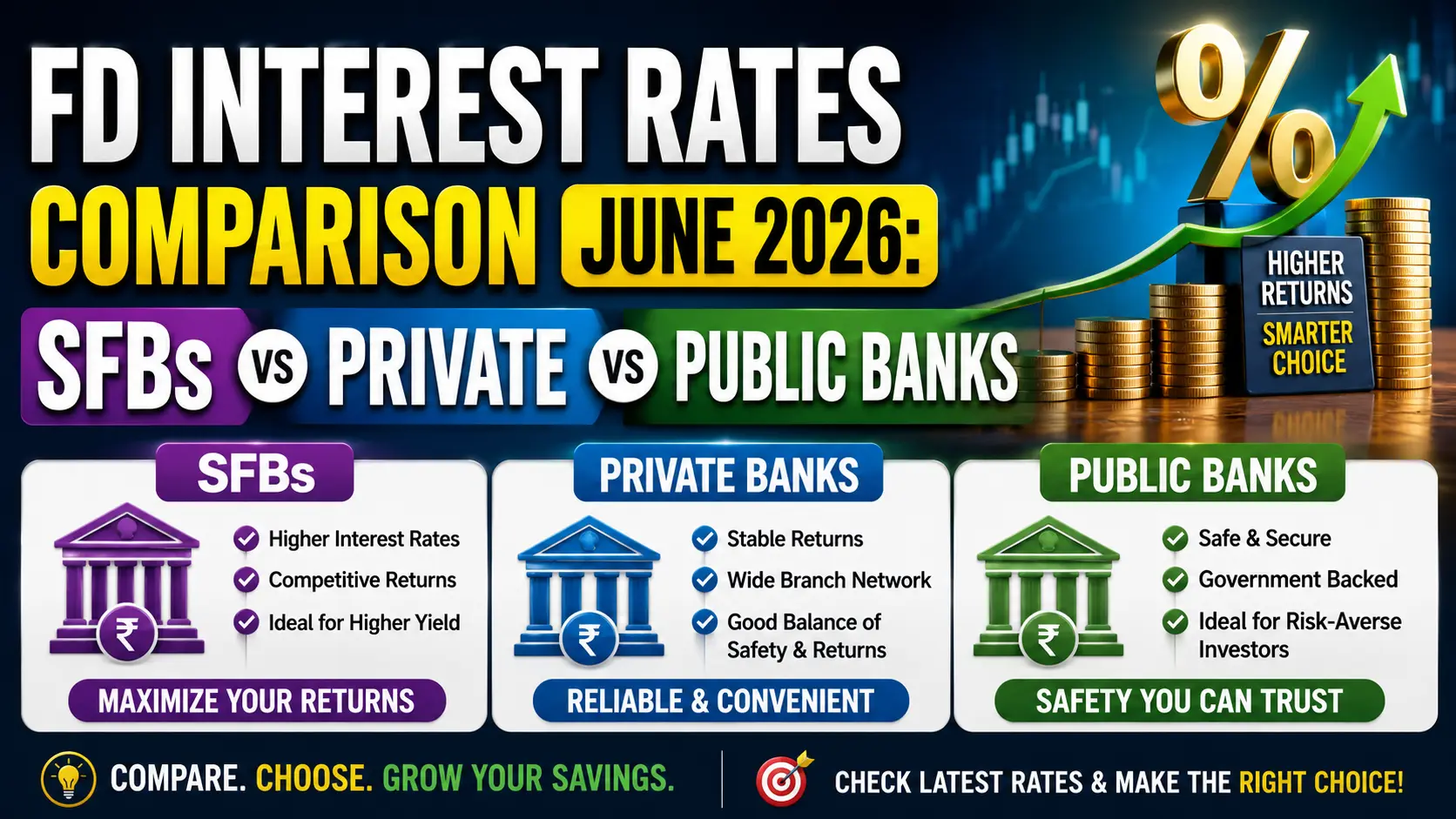
Small Finance Banks are offering higher fixed deposit rates in June 2026 compared to private and public sector banks, making them attractive for investors seeking better returns
Fixed deposits (FDs) continue to be one of the most popular investment options in India. They are safe, simple, and offer guaranteed returns. In June 2026, interest rates on FDs have shown slight changes across different categories of banks. Small Finance Banks (SFBs) are offering higher returns compared to private and public sector banks. This trend is attracting many investors, especially senior citizens and risk-averse individuals.
Small Finance Banks FD Rates
Small Finance Banks are currently leading in terms of FD interest rates. These banks are offering rates between 7.50% and 9.00% per annum for general customers. For senior citizens, rates can go even higher, sometimes touching 9.50%.
Some of the top SFBs are providing strong returns on deposits with tenures ranging from 1 year to 3 years. These banks are trying to attract more deposits to expand their lending capacity. As a result, they offer better interest rates than larger banks.
However, investors should also note that SFBs are relatively smaller in size. While deposits up to ₹5 lakh are insured under DICGC, it is still important to diversify investments.
Private Sector Banks FD Rates
Private sector banks are offering moderate FD rates in June 2026. The interest rates usually range between 6.75% and 7.75% per annum for general customers. Senior citizens may get an additional 0.25% to 0.50%.
These banks are known for their strong digital services and customer support. They also provide flexible FD options like premature withdrawal and loan against FD. While the returns are lower than SFBs, many investors prefer private banks for their stability and brand value.
Short-term FDs of less than one year are currently offering lower returns. However, longer tenures of 2–3 years provide slightly better rates.
Public Sector Banks FD Rates
Public sector banks (PSBs) are offering the lowest FD interest rates among the three categories. In June 2026, rates are mostly between 6.25% and 7.25% per annum for general customers.
These banks focus more on safety and government backing. Many investors trust PSBs because they are backed by the government. Senior citizens still get slightly higher rates, but overall returns remain lower than SFBs and private banks.
PSBs are suitable for conservative investors who prefer stability over higher returns. They are also a good option for large deposits where safety is the main concern.
Tenure-Based Comparison
Interest rates vary depending on the tenure of the FD. Here is a simple comparison:
- Short-term (6 months to 1 year): Lower returns across all banks
- Medium-term (1 to 3 years): Best rates offered, especially by SFBs
- Long-term (above 5 years): Rates are stable but not very high
Most banks are currently offering their best rates in the 1–3 year category. This is a good option for investors who want a balance between returns and liquidity.
What Should Investors Do?
Investors should not look at interest rates alone. They should also consider safety, liquidity, and their financial goals.
- For higher returns, SFBs are a good choice
- For balanced safety and service, private banks are suitable
- For maximum safety, public sector banks are preferred
It is also wise to spread investments across different banks instead of putting all money in one place.
Disclaimer: All the information provided in this article is for educational and infomational purposes only. DateUpdateGo always advises seeking guidance from a certified financial advisor before making any investment-related decisions.
